

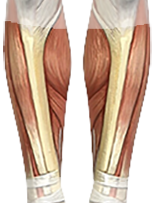
Leg Pain
In this section, you will find information about leg pain and other related symptoms. We will review the most common diagnoses, the muscles that may be involved, and treatment and self-care strategies that can help you improve.
You will also find warning signs that indicate when it is advisable to consult a healthcare professional.
1. Common Symptoms and Diagnoses
Symptoms:
- Deep, diffuse, sharp, or stabbing pain in the back of the leg, pain behind the knee.
- Sensation of pressure or tightness in the calves, limited range of motion in dorsiflexion (pulling the toes upward), sensation of the muscle “balling up,” and nocturnal cramps.
Diagnoses:
- Compartment syndrome, nocturnal cramps, periostitis, vascular problems, Achilles tendinopathy, pseudosciatica, L5-S1 disc herniations.
2. Possible Muscles Involved
Glutes
- Common symptoms: Pain in the lateral and posterior regions of the knee; pain in the posterior and lateral regions of the leg, extending to the ankle; pain when lying down or sitting for extended periods; pseudo-sciatica; pain due to overuse when walking or running.
- Complete self-treatment.
Gastrocnemius and Soleus
- Common symptoms: Pain in the calf and the back of the knee, extending down to the Achilles tendon and the sole of the foot. Intense pain caused by nocturnal cramps or prolonged standing; pain due to overuse when walking or running uphill. A sensation of tightness, restricted mobility, and internal pressure.
- Complete self-treatment.
Peroneals
- Common symptoms: Pain on the lateral side of the leg and ankle. Persistent pain following ankle sprains; sensation of ankle instability and a lack of strength and balance.
- Complete self-treatment.
Hamstrings
- Common symptoms: Pain in the back of the thigh and the back of the knee, extending to the upper calf. Pain when sitting with prolonged pressure on those muscles.
- Complete self-treatment.
3. Treatments
The goal of treatment is to reduce pain, improve mobility, and restore normal function to the affected region. In most cases, these symptoms are related to muscular alterations, overuse, or lack of movement, and can improve with simple self-care measures.
Treatment techniques: These self-applied techniques will help you reduce pain, improve function, and enhance your quality of life.
● Sensitive point compression
Apply progressive pressure on painful points for 60–90 seconds to reduce muscle tension and pain.
● Self-massage: Self-massage helps reduce muscle tension, improve circulation, and decrease pain.
Perform longitudinal, transverse, or fascial massages to relax muscles and improve mobility.
● Post-isometric relaxation and stretching: Help normalize muscle tone, reduce stiffness, and restore movement.
● Mobility and strengthening: Improve function, reduce overuse and stiffness, and help prevent relapses. They also improve tolerance to daily life activities.
This is the most effective strategy in the medium and long term.
● Habit modification: Small daily changes can make a big difference:
-
Avoid maintaining prolonged postures.
-
Take active breaks.
-
Vary your position frequently.
-
Adapt and make the most of your work environment if necessary.
Access specific treatment in the “possible muscles involved” section.
4. Red Flags
If you experience these symptoms, see a doctor without delay:
- Very red, hot leg with effusion (fluid). Feeling of pressure.
- Fever and general malaise.
- Cold, pale or bluish, numb, tingling leg.
- Deformity, instability.
- Loss of strength or foot control.
- Constant nocturnal pain that does not change with position.

