

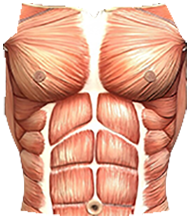
Torso pain
In this section, you will find information about torso pain and other related symptoms. We will review the most frequent diagnoses, the muscles that may be involved, and the treatment and self-care strategies that can help you improve.
You will also find warning signs (red flags) that indicate when it is necessary to consult a doctor without delay.
1. Common symptoms and diagnoses
Symptoms:
- Stabbing pain, like a knot or burning in the chest wall, reproduced by pressing certain back or chest muscles, worsening with movement, exercise, deep breathing, or moving the arms or torso.
- Bloated feeling. Limited torso mobility.
Diagnoses:
- Thoracic radiculopathy, herniated disc, rib fissure, arthritis, Herpes Zoster (shingles), spondylosis, spondylolisthesis, vertebral block, vertebral fracture, visceral pathology, appendicitis, colic, gastritis.
2. Possible muscles involved
Paravertebrals
- Common symptoms: Pain in the lumbosacral region, iliac crest, and buttocks. Sometimes projected towards the abdominal region and lower ribs. Overload pain, a feeling of tightness like a cord lateral to the spine. Typical sensation of whiplash or getting “stuck” during a sudden back flex-extension movement.
- Complete self-treatment.
Abdominals
- Common symptoms: Lower back and abdominal pain. Sometimes this pain is associated with appendicitis or dysmenorrhea.
- Complete self-treatment.
Scalenes
- Common symptoms: Interscapular pain, chest pain.
- Complete self-treatment.
Pectorals
- Common symptoms: Chest pain, pain in the inner arm and elbow.
- Complete self-treatment.
3. Treatments
The goal of treatment is to reduce pain, improve mobility, and restore normal function to the affected region. In most cases, these symptoms are related to muscle alterations, overload, or lack of movement, and can improve with simple self-care measures.
Treatment techniques: These self-applied techniques will help you reduce pain, improve function, and enhance your quality of life.
● Compression of sensitive points
Apply progressive pressure on painful points for 60–90 seconds to reduce muscle tension and pain.
● Self-massage: Self-massage helps reduce muscle tension, improve circulation, and decrease pain.
Perform longitudinal, transverse, or fascial massages to relax the muscles and improve mobility.
● Post-isometric relaxation and stretching: These help normalize muscle tone, reduce stiffness, and recover movement.
● Mobility and strengthening: These improve function, reduce overload and stiffness, and help prevent relapses. They also improve tolerance for activities of daily living.
This is the most effective strategy in the medium and long term.
● Habit modification: Small changes in your daily routine can make a big difference:
-
Avoid holding prolonged postures.
-
Take active breaks.
-
Change positions frequently.
-
Adapt and make the most of your work environment if necessary.
Access specific treatment in the “possible muscles involved” section.
4. Red flags
In case of these symptoms, see a doctor without delay:
- Oppressive chest pain radiating to the arm, neck, or jaw that appears with exertion and is accompanied by shortness of breath (dyspnea) or cold sweats, nausea, or vomiting.
- Dyspnea, persistent cough, fever, coughing up blood.
- Constant pain, day and night, that does not improve with postural changes.
- Weight loss without apparent cause and persistent fatigue.
- History of cancer.

