

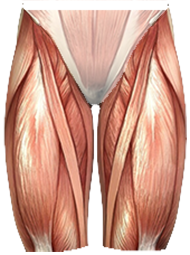
Thigh and Hip Pain
In this section you will find information about thigh and hip pain and other related symptoms. We will review the most common diagnoses, the muscles that may be involved, and the treatment and self-care strategies that can help you improve.
You will also find warning signs (red flags) that indicate when it is necessary to consult a doctor without delay.
1. Common Symptoms and Diagnoses
Symptoms:
- Thigh pain, superficial or deep and dull, on the front or back, pain toward the groin, pain when running, pain when going up or down stairs, when sitting or standing up, when remaining seated.
- Feeling of weakness, stiffness and hardness in the thigh, locking at the knee level.
Diagnoses:
- Quadriceps tendinopathy, hamstring tendinopathy, iliotibial band syndrome, meralgia paresthetica, external iliac artery endofibrosis, false sciatica, lumbosacral disc herniation.
- Trochanteric bursitis, hip osteoarthritis (coxarthrosis).
2. Possible Muscles Involved
Quadriceps
- Common symptoms: Deep anterior thigh pain, sometimes radiating to the knee, pain on the lateral side, trochanter area (bursitis, trochanteritis), feeling of weakness or knee giving way. Pain when running, going up or down stairs, sitting or standing up.
- Feeling of weakness, stiffness and hardness in the thigh, locking at the knee level.
- Complete self-treatment.
Adductors
- Frequent symptoms: Pain on the inner side of the thigh, in the groin, sometimes going down to the knee. Pain in the abdominal and pubic region. Pubalgia, pelvic pain. Pain when closing the legs, kicking a soccer ball, riding a horse, etc.
- Complete self-treatment.
Glutes
- Frequent symptoms: Pain in the lateral and posterior region of the thigh. Pain when lying down or sitting for a long time, pseudosciatica, overload pain when walking or running.
- Complete self-treatment.
Iliopsoas
- Common symptoms: Pain in the anterior and upper thigh region, groin pain, lower back pain, pain and weakness when going uphill or climbing stairs. Discomfort when extending the leg backward, when straightening up in the morning, or when sitting for a long time with sustained hip flexion.
- Complete self-treatment.
Hamstrings
- Common symptoms: Pain in the back of the thigh, pain near the glute, pain in the back of the knee, pain when sitting with weight on this muscle group, discomfort and difficulty bending the trunk, posterior stiffness and tension. Muscle group prone to muscle tears (hematoma, sharp pain, exquisite pain, weakness and pain with movement).
- Complete self-treatment.
3. Treatments
The goal of treatment is to reduce pain, improve mobility, and restore normal function to the affected region. In most cases, these symptoms are related to muscular alterations, overuse, or lack of movement, and can improve with simple self-care measures.
Treatment techniques: These self-applied techniques will help you reduce pain, improve function, and enhance your quality of life.
● Sensitive point compression
Apply progressive pressure on painful points for 60–90 seconds to reduce muscle tension and pain.
● Self-massage: Self-massage helps reduce muscle tension, improve circulation, and decrease pain.
Perform longitudinal, transverse, or fascial massages to relax muscles and improve mobility.
● Post-isometric relaxation and stretching: Help normalize muscle tone, reduce stiffness, and restore movement.
● Mobility and strengthening: Improve function, reduce overuse and stiffness, and help prevent relapses. They also improve tolerance to daily life activities.
This is the most effective strategy in the medium and long term.
● Habit modification: Small daily changes can make a big difference:
-
Avoid maintaining prolonged postures.
-
Take active breaks.
-
Vary your position frequently.
-
Adapt and make the most of your work environment if necessary.
Access specific treatment in the “possible muscles involved” section.
4. Red Flags
If you experience these symptoms, see a doctor without delay:
- Very intense pain, total inability to bear weight with obvious thigh deformity and rapidly appearing massive hematoma.
- Marked pallor, coldness of the thigh or leg, disproportionate and progressive pain.
- Fever. Marked swelling of the thigh, feeling of warmth, pain on deep palpation, erythema or purplish tone, worsens when standing for prolonged periods.
- Sudden weakness and loss of strength, tingling or loss of sensation.

