

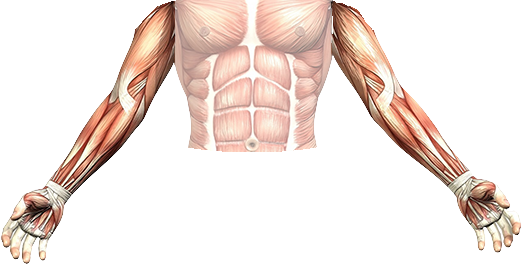
Arm, wrist, and hand pain
In this section, you will find information about arm, forearm, and hand pain, as well as other related symptoms. We will review the most frequent diagnoses, the muscles that may be involved, and the treatment and self-care strategies that can help you improve.
You will also find warning signs (red flags) that indicate when it is necessary to consult a doctor without delay.
1. Common symptoms and diagnoses
Symptoms:
-
Pain in the arm, forearm, or hand; pain when gripping objects; pain radiating toward the hand or fingers; thumb pain; intense elbow pain.
-
Feeling of weakness in the hand, fatigue when using the arm or hand, feeling of stiffness or overload, difficulty pinching, opening jars, holding weights, turning knobs, or using tools (screwdriver). Tingling or strange sensations without a neurological cause.
Diagnoses:
- Carpal tunnel syndrome, thoracic outlet syndrome, epicondylitis (tennis elbow), rhizarthrosis, De Quervain’s tenosynovitis, C5-C7 radiculopathy.
2. Possible muscles involved
Scalenes
- Common symptoms: Neck, arm, and forearm pain; pain between the shoulder blades and in the chest. Tingling sensation, numb hand, and lack of strength (thoracic outlet syndrome). Epicondylitis.
- Complete self-treatment.
Pectorals
- Common symptoms: Pain in the front of the shoulder, in the chest, in the sternum, inner side of the arm and elbow, reaching down to the hand. Tingling and loss of strength in the arm and hand. Thoracic outlet syndrome. Carpal tunnel syndrome. Epitrochleitis.
- Complete self-treatment.
Epicondylar muscles
- Common symptoms: Pain in the forearm, in the elbow bone, in the wrist, and palm of the hand. Tingling and loss of strength in the hand. Difficulty gripping objects, manipulating tools, etc. Diagnoses of thoracic outlet syndrome, carpal tunnel syndrome, epicondylitis, or tennis elbow.
- Complete self-treatment.
Hand muscles
- Common symptoms: Pain in the wrist, in the palm of the hand, and in the fingers. Tingling and loss of strength in the hand. Difficulty gripping objects, manipulating tools, and pinching. Diagnoses of thoracic outlet syndrome, carpal tunnel syndrome, De Quervain’s tenosynovitis, rhizarthrosis, arthritis.
- Complete self-treatment.
Triceps brachii
- Common symptoms:
- Complete self-treatment.
Biceps brachii and brachialis
- Common symptoms:
- Complete self-treatment.
3. Treatments
The goal of treatment is to reduce pain, improve mobility, and restore normal function to the affected region. In most cases, these symptoms are related to muscle alterations, overload, or lack of movement, and can improve with simple self-care measures.
Treatment techniques: These self-applied techniques will help you reduce pain, improve function, and enhance quality of life.
● Compression of tender points
Apply progressive pressure on painful points for 60–90 seconds to reduce muscle tension and pain.
● Self-massage: Self-massage helps reduce muscle tension, improve circulation, and decrease pain.
Perform longitudinal, transverse, or fascial massages to relax the muscles and improve mobility.
● Post-isometric relaxation and stretching: These help normalize muscle tone, reduce stiffness, and restore movement.
● Mobility and strengthening: These improve function, reduce overload and stiffness, and help prevent relapses. They also improve tolerance for activities of daily living.
This is the most effective strategy in the medium and long term.
● Habit modification: Small changes in your daily routine can make a big difference:
-
Avoid maintaining prolonged postures.
-
Take active breaks.
-
Change positions frequently.
-
Adapt and make the most of your work environment if necessary.
Access specific treatment in the “possible muscles involved” section.
4. Red flags
In the presence of these symptoms, see a doctor without delay:
- Pain in the left arm that appears with exertion and is accompanied by chest pressure, shortness of breath (dyspnea), or cold sweats.
- Intense, disproportionate pain, or a feeling of extreme internal pressure.
- Deformity of the arm or hand, especially after trauma or a fall.
- Fever, or an arm or hand that is red, hot, and swollen.
- Weakness in the arm and hand, loss of strength when gripping objects.
-
Sudden paleness, coldness, or bluish color in the limb.
- Persistent tingling in the arm and hand.

