

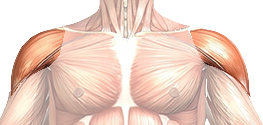
Shoulder Pain
In this section, you will find information about shoulder pain and other related symptoms. We will review the most common diagnoses, the muscles that may be involved, and treatment and self-care strategies that can help you improve.
You will also find warning signs (red flags) that indicate when it is necessary to consult a doctor without delay.
1. Common Symptoms and Diagnoses
Symptoms:
- Superficial or deep shoulder pain, joint pain, pain when moving the arm, pain in bed.
- Limited mobility, weakness, lack of coordination, joint clicking.
Diagnoses:
- Subacromial bursitis, supraspinatus tendinopathy, subacromial syndrome, C5–C6 radiculopathy, cervical disc herniation, adhesive capsulitis, frozen shoulder, rotator cuff tendinopathy.
2. Possible Muscles Involved
Infraspinatus
- Common symptoms: Deep pain in the front of the shoulder, joint pain across the shoulder, pain in the side of the arm. Feeling of arm heaviness, tingling in the hand, difficulty putting on a jacket or fastening a bra. Weakness in external shoulder rotation.
- Complete self-treatment.
Pectoral muscles
- Common symptoms: Pain in the front of the shoulder, chest, sternum, inner arm and elbow. Feeling of tension and rounded shoulders. Headache, discomfort from clothing rubbing against the skin. Tingling and loss of strength in the arm and hand. Thoracic outlet syndrome. Epitrochleitis.
- Complete self-treatment.
Deltoids
- Common symptoms: Pain throughout the shoulder, depending on the affected region of the muscle. Muscle weakness, painful “catching” sensation when initiating arm elevation. Restricted mobility in internal rotation (posterior deltoid) or external rotation (anterior deltoid). Sometimes diagnosed as biceps brachii tendinopathy.
- Complete self-treatment.
Scalenes
- Common symptoms: Neck, arm, and forearm pain, pain between the shoulder blades and in the chest. Tingling sensation, numb and weak hand (thoracic outlet syndrome). Epicondylitis.
- Complete self-treatment.
Levator Scapulae
- Common symptoms: Pain in the back of the shoulder. Stiffness, torticollis, inability to turn the head to the affected side. Difficulty lifting the arm.
- Complete self-treatment.
3. Treatments
The goal of treatment is to reduce pain, improve mobility, and restore normal function to the affected region. In most cases, these symptoms are related to muscular alterations, overuse, or lack of movement, and can improve with simple self-care measures.
Treatment techniques: These self-applied techniques will help you reduce pain, improve function, and enhance your quality of life.
● Sensitive point compression
Apply progressive pressure on painful points for 60–90 seconds to reduce muscle tension and pain.
● Self-massage: Self-massage helps reduce muscle tension, improve circulation, and decrease pain.
Perform longitudinal, transverse, or fascial massages to relax muscles and improve mobility.
● Post-isometric relaxation and stretching: Help normalize muscle tone, reduce stiffness, and restore movement.
● Mobility and strengthening: Improve function, reduce overuse and stiffness, and help prevent relapses. They also improve tolerance to daily life activities.
This is the most effective strategy in the medium and long term.
● Habit modification: Small daily changes can make a big difference:
-
Avoid maintaining prolonged postures.
-
Take active breaks.
-
Vary your position frequently.
-
Adapt and make the most of your work environment if necessary.
Access specific treatment in the “possible muscles involved” section.
4. Red Flags
In case of these symptoms, consult a doctor without delay:
- Left shoulder pain that appears with exertion and is accompanied by chest pressure, shortness of breath (dyspnea), or cold sweats.
- Shoulder deformity, especially after trauma or a fall.
- Fever, red, hot, and swollen shoulder.
- Total inability to move the arm.
- Weakness in arm and hand, loss of grip strength.
-
Pallor, coldness, or changes in limb color.
- Persistent tingling in arm and hand.
-
Shoulder pain at rest accompanied by persistent cough, dyspnea, or chest pain.

